Gallium nitride (GaN)–based semiconductors are anticipated to serve as next-generation power device materials to replace silicon (Si). Owing to their superior physical properties, such as a wide bandgap and high electron mobility, GaN-based semiconductors have been extensively researched and developed, along with silicon carbide (SiC)¹. These materials have already been commercialized in high-frequency devices for signal amplification, as well as in power devices for power control and conversion, and their market continues to expand².
In particular, GaN high-electron-mobility transistors (GaN-HEMTs), which require low ON-resistance and high channel mobility, have been successfully fabricated on Si substrates³. As a result, production using 6-inch and 8-inch wafers is now underway. Samco Inc. supplies ICP-RIE and CVD systems for GaN-based light-emitting devices, which are widely used from research and development through mass-production processes. The etching rate, in-plane uniformity, and stability during continuous processing of Samco’s ICP-RIE systems have been highly evaluated by many users.
In this report, continuous device isolation processing of GaN-based power devices formed on 6-inch Si substrates was investigated using the mass-production-ready ICP-RIE system RIE-800iPC. The stability of continuous processing for 25 wafers is reported.
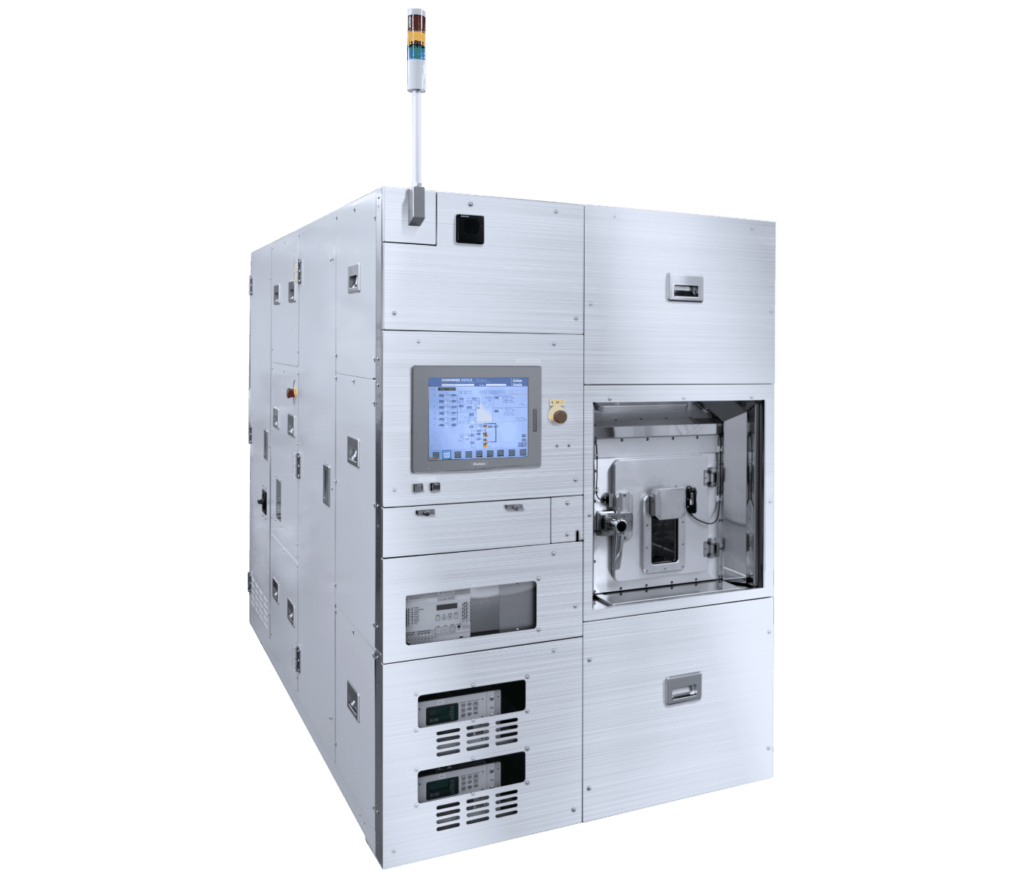
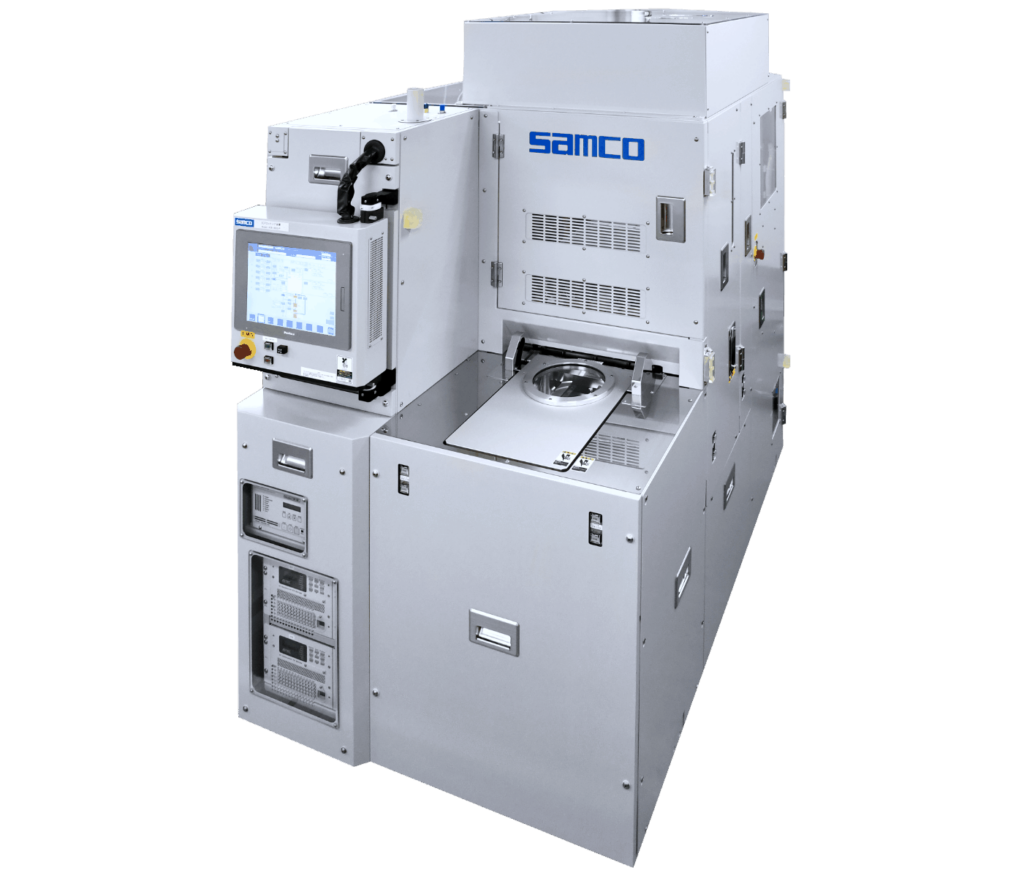
Device isolation etching was performed on a cassette of 25 6-inch Si wafers with a GaN layer using the ICP-RIE system RIE-800iPC to evaluate the stability of a mass-production process. Figure 1 shows the external appearance of the RIE-800iPC. The etched sample structure is shown in Figure 2. A GaN layer with a thickness of approximately 7 µm was formed on a Si substrate, and a photoresist (PR) mask was patterned through exposure and development. The patterned PR mask covered approximately 90% of the wafer, leaving an opening area of about 10%.
Device isolation processing requires etching the GaN layer down to the Si substrate, and this condition must be achieved uniformly across the entire 6-inch wafer. Consequently, some over-etching into the Si substrate is inevitable. Excessive over-etching, however, may cause device damage and height non-uniformity, leading to reduced accuracy in subsequent processes. In addition, variations in GaN layer thickness exist between wafers.
To stabilize the over-etching amount, an optical emission spectroscopy-based endpoint monitor (HORIBA EV-140C) was employed.
Continuous processing of 25 wafers loaded into a single cassette was performed using endpoint detection. The GaN layer thickness of the wafers used in this experiment was approximately 7 µm, with thickness variations of several percent among the wafers. Since etching was performed until the Si substrate was reached based on the endpoint detection recipe, stable etching rates yield etching times that correspond to the GaN film thickness of each wafer.
Figure 3 presents the endpoint detection result and cross-sectional scanning electron microscope (SEM) images at the wafer center for the first wafer in the 25-wafer continuous process, in which over-etching was controlled by automatic etch stop based on endpoint detection. In the endpoint detection graph, the green line represents the emission intensity of nitrogen (N), and the red line represents that of silicon (Si). After completion of GaN etching, the Si emission intensity increased, and the etching was stopped at 648 s when the signal stabilized. Cross-sectional SEM observation confirmed that the GaN layer had been completely etched and that the Si substrate had been reached.
To evaluate within wafer etch uniformity and etching rate stability, the 1st, 13th, and 25th wafers were selected from the lot. Etch depth measurements were conducted using a stylus profilometer, and etching rates were calculated from the etching time. The results are shown in Figure 4.
For the three wafers (1st, 13th, and 25th), step height measurements were performed at nine points excluding the outer 5 mm edge region. The average etching rate was 675 nm/min, in-plane uniformity was <±3%, and the etching rate uniformity within the lot was ±0.35%. These results confirm the stability of the process during continuous processing of 25 wafers.
Finally, the etch stop times for all 25 wafers are shown in Figure 5. The etch stop times ranged from 641 to 670 s, corresponding to a variation of ±2.2%. Given that the etching rate variation was only ±0.35%, this indicates that the variation in etch stop time is primarily due to differences in GaN film thickness between wafers. These results demonstrate the effectiveness of endpoint monitoring in controlling the over-etching amount, even for wafers with several-percent differences in GaN film thickness.
This report has presented a device isolation processing technique for GaN-based power devices using the mass-production-ready ICP-RIE system RIE-800iPC, along with its excellent process stability. Featuring high process reproducibility and superior in-plane etch uniformity, the RIE-800iPC is suitable not only for GaN semiconductor etching but also for a wide range of materials, including compound semiconductors such as GaAs and InP, and Si-based materials such as SiO₂ and SiN. It also supports ferroelectric and metallic materials such as PZT and Pt, as well as polymer materials such as polyimide.
Samco will continue to actively promote the development of process technologies for next-generation devices, contributing to resolving stability issues and improving quality in customers’ mass-production processes.